
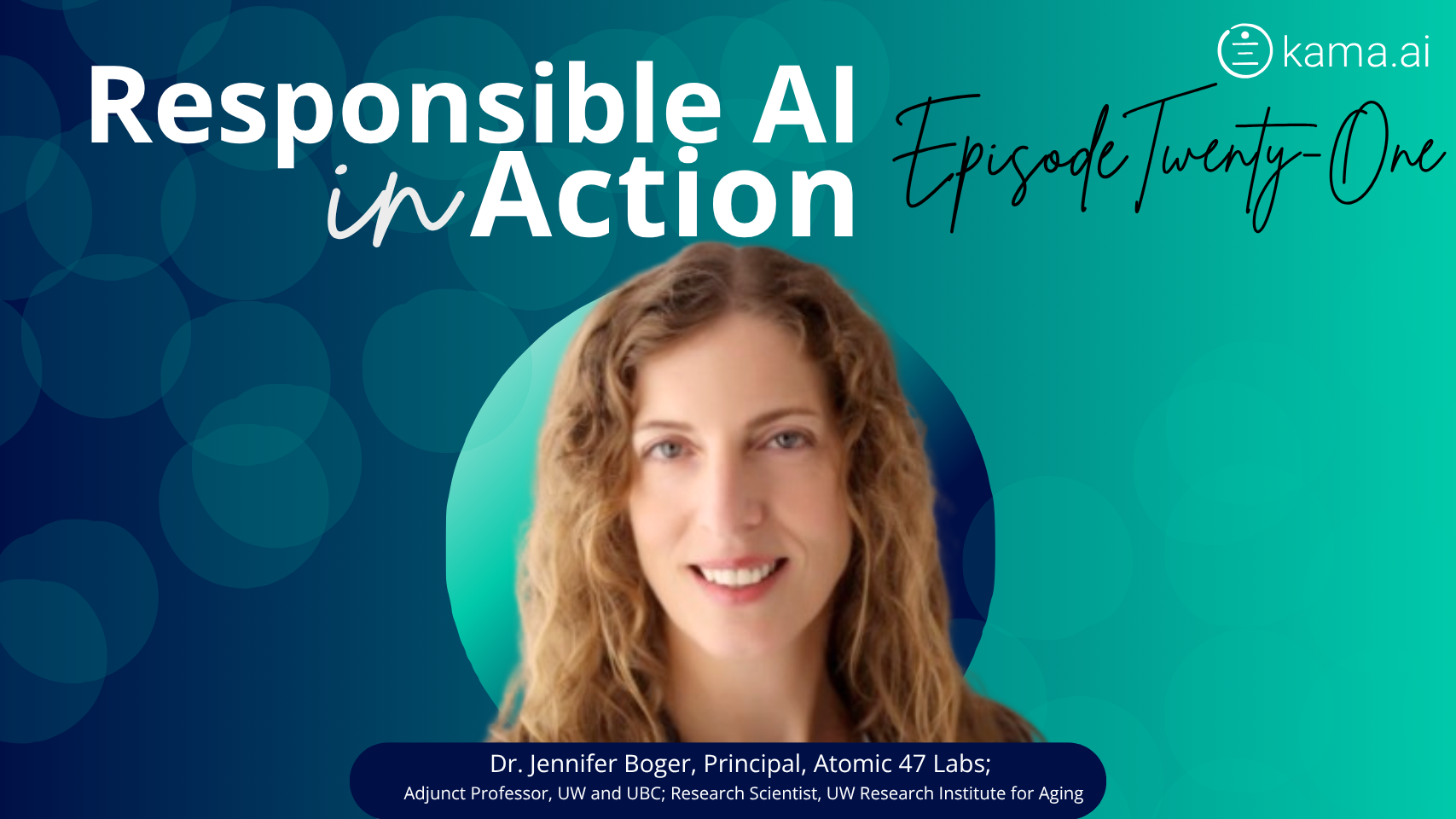
Responsible AI in Action – Episode 21: Designing Trustworthy AI for Real-World Decisions, with Dr. Jennifer Boger
As artificial intelligence evolves from generating answers to taking actions, organizations face a new challenge: how do you design AI systems that are trustworthy, accountable, and safe in real-world environments?
In Episode 21 of Responsible AI in Action, Charles Dimov is joined by Dr. Jennifer Boger, Principal at Atomic 47 Labs, Adjunct Professor at the University of Waterloo and the University of British Columbia, and Research Scientist at the University of Waterloo Research Institute for Aging. Together, they explore what responsible AI looks like as enterprises move beyond experimentation and toward operational AI systems.
The conversation begins by challenging one of AI’s most misunderstood topics: bias. Rather than trying to eliminate bias entirely, Dr. Boger explains why organizations need to understand, identify, and manage bias within the context of their specific applications. She shares practical techniques that every AI user can apply today, including prompts that reveal hidden assumptions in AI-generated responses.
The discussion then shifts to one of today’s biggest enterprise questions: when should AI remain deterministic, and when does it make sense to introduce autonomous capabilities? Dr. Boger explains why AI should be viewed as an organizational capability rather than simply another software tool, and why successful adoption requires long-term governance, strategic planning, and human oversight.
Using aviation as a compelling case study, Charles and Jennifer examine how highly trusted AI systems are developed through rigorous testing, layered safeguards, redundancy, and clear accountability. They discuss how these same principles can help organizations safely deploy AI in industries where errors carry significant consequences.
The episode also explores how organizations can prepare for AI systems that increasingly perform actions instead of simply making recommendations. Dr. Boger emphasizes the importance of controlled testing, continuous learning, transparent decision-making, and creating “brave spaces” where teams openly discuss failures to improve future systems.
Finally, the conversation examines accountability in high-impact industries such as healthcare, where AI can dramatically improve efficiency while keeping qualified professionals firmly in control of critical decisions. The result is a practical discussion on balancing automation with human expertise.
Whether you’re leading AI strategy, implementing enterprise AI, or developing next-generation intelligent systems, this episode offers valuable insights into building AI that organizations—and the people who depend on it—can trust.
Watch the full episode now:
Watch Episode 21 of Responsible AI in Action to learn:
- Why bias cannot be eliminated—and how it should be managed
- How organizations can identify hidden assumptions in AI systems
- When deterministic AI is more appropriate than autonomous AI
- What enterprise leaders can learn from aviation’s approach to AI safety
- Why accountability becomes more complex as AI takes action
- How human oversight remains essential in high-impact environments
- Practical strategies for implementing responsible AI that scales safely
Dr. Jennifer Boger is Principal at Atomic 47 Labs, Adjunct Professor at the University of Waterloo and the University of British Columbia, and Research Scientist at the University of Waterloo Research Institute for Aging.
🎧 Watch Now
Learn more – Follow on LinkedIn: Dr Jennifer Boger