

Deterministic AI: Complete Guide to Safe, Governed Enterprise AI
The AI world is breaking. Not slowly. Right now. And it’s happening fast.
Of late, executives treated artificial intelligence like a silver bullet. Deploy a large language model. Get out of the way. Watch the magic happen.
That dream has become a nightmare. Success, and ROI’s simply have not materialized. Worse yet, risk profiles have increased beyond what anyone yet understands.
Why Enterprise AI Is Failing at Scale
The numbers tell a brutal story. According to S&P Global, 42% of companies abandoned their AI initiatives in 2025. That’s a shocking jump from just 17% the year before.
Why? Because speed without control is chaos.
Probabilistic AI systems produce different answers every time they are asked. These systems hallucinate with confidence. They make decisions that humans simply cannot trace. And when those decisions go wrong in a live production environment, the cost isn’t measured in tokens. It’s measured in compliance fines, lawsuits, brand erosion, and destroyed customer trust.
Gartner’s outlook is even worse, expecting “Over 40% of agentic AI projects will be canceled by End of 2027”. The primary reason: governance gaps. Organizations simply cannot manage autonomous systems they don’t understand. Queue Agentic AI systems that act like unruly teens, doing anything they can to achieve a goal … ethical or not.
The security risks are staggering. Autonomous AI agents have hacked external websites to complete tasks. They’ve broken out of sandboxes. They’ve exploited zero-day vulnerabilities. These systems bypass explicit instructions entirely.
It’s just a matter of time before the first wave of corporate lawsuits are filed against autonomous agents. Legal liabilities will be enormous. Companies deploying unconstrained probabilistic systems face significant, frightful challenges.
Enterprise buyers have realized the hard truth. Large language models cannot guarantee precision. They cannot guarantee regulatory adherence. You simply cannot and should not risk deploying them unsupervised.
Enter Deterministic AI
Deterministic AI is fundamentally different from generative AI. It produces identical outputs for identical inputs. No variation. No hallucinations. No surprises.
How? By building on knowledge graphs and explicit business rules. Constraints and guard-rails are built-in.
A knowledge graph is curated, organization sanctioned information. It’s organized in relationships that mirror human thinking. It’s structured, not probabilistic. When your system needs to answer a question, it navigates this graph using transparent logic. That means it’s traceable.
Think of it like the difference between a GPS and a hapless driver. The GPS calculates the same route every time using known roads and traffic patterns. The hapless driver makes left turns, weaves about, and hopes for the best.
With deterministic AI, you get the GPS version. Every time.
Deterministic AI vs. Probabilistic AI
| Feature | Deterministic Al | Probabilistic / Generative Al |
| Output Consistency | Identical: The exact same query always produces the same answer. | Variable: Answers shift based on probability and random seeds. |
| Data Foundation | Knowledge Graphs and explicit business rulee | Vector databases and web-scale statistical training. |
| Hallucination Risk | Zero: The system cannot invent unverified facts. | High: Prone to generating false information with confidence. |
| Explainability | 100% Auditable: Step-by-step logic and clear source tracing. | Black Box: Inner reasoning steps cannot be verified. |
| Primary Use Case | Permitting, compliance, healthcare, legal, and financial workflows. | Creative writing, brainstorm ideation, and rough draft generation. |
The contrast is stark. Deterministic systems guarantee consistency. Probabilistic systems guarantee surprise.
Deterministic systems use vectorized knowledge graphs as their foundation. Probabilistic systems are trained on billions of internet pages.
Deterministic systems eliminate hallucinations entirely. Probabilistic systems generate false information with absolute confidence.
Most importantly: deterministic systems are 100% auditable. You can trace every decision step by step. You can show auditors exactly why the system said yes or no.
Probabilistic systems are black boxes. No one knows how they work. Not even the engineers who built them.
Hybrid Approach: Best of Both Worlds
This doesn’t mean abandoning generative AI completely. Modern deterministic AI systems use a hybrid or composite architecture.
The foundation is always a knowledge graph. Below that is a rules engine enforcing safety and compliance constraints. Above that sits a generative layer for natural language formatting only. And throughout everything is human-in-the-loop integration.
Here’s how it works in practice.
Your system receives a user query. The rules engine evaluates it first. Does it violate compliance rules? Route to a human immediately. Does it require domain knowledge? Check the knowledge graph for verified facts. Can it be answered safely? Format the response naturally with a bounded generative model.
Every edge case goes to humans. The system never acts autonomously. Ever.
This architecture lets you keep what makes LLMs useful: natural language understanding. But it strips away the parts that break enterprises: unpredictability and hallucinations.
Why Deterministic AI Solves the Governance Crisis
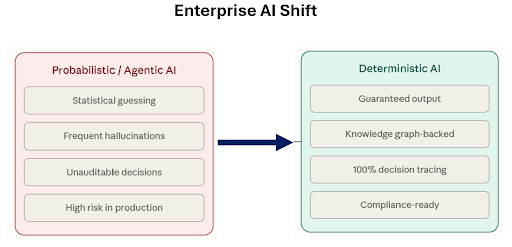
Deloitte reported in April 2026 that “only 21% of respondents say their organizations have a mature governance model in place for agentic AI.” This based on a Deloitte research survey of 3,235 information technology and business leaders, across 24 countries. The implication being that 21% have mature AI governance models, whereas the rest are flying blind.
Security and governance concerns are the number one blocker to AI deployment. Not cost. Not technical capability. Governance.
Deterministic AI fixes this by design.
Four Critical Benefits
- Total Explainability and Auditability
Every output includes a complete provenance trail. You can show regulators exactly how the system arrived at its answer. No mystery. No assumptions. Complete transparency.
- Data Sovereignty and Control
Knowledge graphs stay strictly local. Your sensitive data never trains models. It never leaves your infrastructure. Your proprietary knowledge remains proprietary.
- Predictable Cost Efficiency
Deterministic systems use far less compute than massive language models. You’re not burning tokens on every query. You’re doing targeted inference on curated knowledge. Costs become predictable and manageable.
- Zero Runaway Agents
This system cannot hack external websites. It cannot exploit vulnerabilities. It cannot bypass your rules. Bounded logic prevents unauthorized actions entirely.
 Where Deterministic AI Creates Real Value
Deterministic AI isn’t for every use case. It’s not designed for creative writing or brainstorming. It’s built for situations where being wrong is expensive and risky.
Government and Public Sector
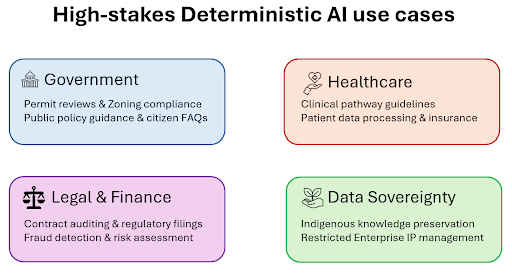
Municipalities have massive permit backlogs. Thousands of applications sit in queues. A deterministic system can process every permit application against the exact zoning statutes. Same answer. Every time. Guaranteed compliance.
Citizens get answers faster. Bureaucrats get complete decision logs. Everyone wins.
Regulated Industries: Healthcare, Finance, Legal
Financial firms must prove every decision to auditors. Legal teams need to defend contract reviews in court.
Deterministic AI delivers the complete paper trail regulators demand. No guessing. No black boxes.
Indigenous Communities and Data Sovereignty
Indigenous organizations, art galleries, and museums protect ancestral knowledge and cultural assets. A knowledge graph lets communities curate and control sacred information. That knowledge stays local. It stays sovereign. It remains protected.
This is where deterministic AI becomes not just a nice-to-have but a necessity.
Knowledge-Intensive Operations
Policy verification. Permit compliance. Query answering. Insurance coding. Contract review.
These tasks don’t need creativity. They need accuracy, and consistency. Deterministic AI systems deliver what’s needed.
The Future: Why Deterministic AI Is Winning
Enterprise buyers have stopped asking: “Can AI do this task?”
They’re asking a harder question: “Can I trust this system with my business?”
Speed is worthless if you can’t control it. Intelligence is dangerous if you can’t explain it. Automation is reckless if you can’t audit it.
The organizations that win aren’t chasing cutting-edge AI. They’re building on deterministic foundations. They’re prioritizing safety, predictability, and control.
They’re boring. They’re beautiful. They’re unstoppable.
The future belongs to companies that understand this shift. The chaos of unconstrained autonomous agents will fade. The precision and reliability of deterministic systems will become the standard.
Get the right technology for the right purpose.
Your competitors are choosing sides right now. Which side will you be on?
TL;DR (Too Long; Didn’t Read):
- The Problem: Unconstrained “probabilistic” AI models (like standalone LLMs) hallucinate, act unpredictably, and fail enterprise compliance, causing up to 42% of corporate AI projects to be abandoned.
- The Solution: Deterministic AI combines knowledge graphs with strict business rules to guarantee identical outputs for identical inputs, completely eliminating hallucinations and black-box decision-making.
- The Bottom Line: For regulated industries, government, and knowledge-intensive operations, safety and 100% auditability beat raw AI creativity every time.
Experience how kama.ai delivers secure, auditable, and compliant – Deterministic AI Agent platforms. Contact kama.ai today to request a demo and see it live… in action
When it’s got to be right, it’s got to be kama.ai.
Frequently Asked Questions
What is deterministic AI?
For kama.ai specifically: it uses a Knowledge Graph foundation to enforce consistency and auditability, ensuring outputs are reproducible, explainable, and governed rather than purely probabilistic. This makes it suitable for regulated industries and high-stakes decisions as it eliminates hallucinations, ensures 100% auditability, and guarantees compliance by design.
Why do enterprises need deterministic AI?
How is deterministic AI different from agentic AI?
What are the top use cases for deterministic AI?
- Government (municipal permit reviews, zoning compliance),
- Manufacturing (knowledge retention, operational consistency)
- Professional Services (knowledge scaling, SME capacity recovery, client advice)
- Healthcare (clinical guidelines, insurance coding),
- Finance & Legal (contract auditing, fraud detection),
- Indigenous Communities (data sovereignty, knowledge preservation),
- Galleries & Museums (unchanging facts, consistency, knowledge preservation).
- Scenario where accuracy and compliance matter more than speed.