


Fear Is Loud, but the Data Is Calmer
Over the past year, anxiety around AI-driven job losses has intensified. Headlines throughout 2025 focused heavily on layoffs across major technology firms. In many cases, artificial intelligence was cited as a contributing factor. These stories fueled concern about widespread displacement and economic disruption.
The narrative has been simple and alarming. AI arrives. Jobs disappear. Workers lose. That framing spreads quickly, especially during uncertain economic periods. It resonates emotionally, even when evidence remains incomplete.
Yet beneath the headlines, a more complex reality is emerging. Several organizations that moved quickly to reduce staff later reversed those decisions. Swedish company Klarna was a famous notable example of this in 2025. Employees were rehired after leadership recognized the cuts due to AI replacements, were premature. Institutional knowledge vanished. Operational continuity suffered. AI systems were not ready to replace judgment, accountability, initiative, or context.
At the same time, enterprise AI performance has been underwhelming. Research consistently shows that most AI initiatives fail to reach production or generate value. According to MIT’s State of AI in Business 2025 study, despite $30–40 billion invested in enterprise GenAI, “95% of organizations are getting zero return,” with only 5% of AI pilots reaching production with measurable P&L impact. When technology struggles this significantly to deliver returns, mass job elimination becomes an unlikely outcome. The real challenge is not human redundancy. It is execution, governance, and alignment with real business workflows.
Fear Is Loud, but the Data Is Calmer
Over the past year, anxiety around AI-driven job losses has intensified. Headlines throughout 2025 focused heavily on layoffs across major technology firms. In many cases, artificial intelligence was cited as a contributing factor. These stories fueled concern about widespread displacement and economic disruption.
The narrative has been simple and alarming. AI arrives. Jobs disappear. Workers lose. That framing spreads quickly, especially during uncertain economic periods. It resonates emotionally, even when evidence remains incomplete.
Yet beneath the headlines, a more complex reality is emerging. Several organizations that moved quickly to reduce staff later reversed those decisions. Swedish company Klarna was a famous notable example of this in 2025. Employees were rehired after leadership recognized the cuts due to AI replacements, were premature. Institutional knowledge vanished. Operational continuity suffered. AI systems were not ready to replace judgment, accountability, initiative, or context.
At the same time, enterprise AI performance has been underwhelming. Research consistently shows that most AI initiatives fail to reach production or generate value. According to MIT’s State of AI in Business 2025 study, despite $30–40 billion invested in enterprise GenAI, “95% of organizations are getting zero return,” with only 5% of AI pilots reaching production with measurable P&L impact. When technology struggles this significantly to deliver returns, mass job elimination becomes an unlikely outcome. The real challenge is not human redundancy. It is execution, governance, and alignment with real business workflows.
Media Narratives Versus Measured Reality
A review of media coverage from mid-2025 through early-2026 reveals a divided conversation. Roughly half of articles still predict large-scale white-collar job elimination. These pieces portray AI as a net destroyer of professional roles. Most focus heavily on knowledge work.
Another significant portion (about 30%) presents a more measured perspective. These articles suggest AI will transform jobs rather than erase them. Responsibilities will shift. Skills will evolve. Workflows will change. Jobs remain, but their shape adjusts.
A smaller share remains neutral or mixed. These stories acknowledge uncertainty without dramatic conclusions. What stands out most is a gradual tonal shift. Optimism is slowly re-entering the discussion. While disruption is expected, collapse appears unlikely.
This shift aligns with economic data and historical precedent. Technology rarely eliminates work entirely. It reallocates effort and creates new demands.
Job Chaos, Not Collapse
Research from leading institutions reinforces this conclusion. Certain white-collar roles will face pressure as AI substitutes specific tasks. Marketing operations, design execution, administrative coordination, call handling, and software development already show signs of change.
However, even conservative projections show limited net impact. Goldman Sachs estimates that if AI were broadly deployed, approximately 2.5% of U.S. employment would be at risk of displacement. Even in this scenario, the impact is expected to be temporary. Historically, “technology-driven disruption fades within two years as labor markets adjust.”
This pattern reflects frictional unemployment, not structural collapse. Frictional unemployment accompanies innovation across eras. It resolves as new roles emerge and productivity gains expand opportunity.
Gartner’s analysis paints an even clearer picture. Their research forecasts that starting in 2028–2029, AI will create more jobs than it eliminates. Each year, “over 32 million roles will be transformed, not removed.” These jobs will be redesigned, augmented, or refactored.
This distinction matters. Transformation demands effort, training, and leadership. It does not signal extinction.
 Layoffs Rarely Come From AI Productivity
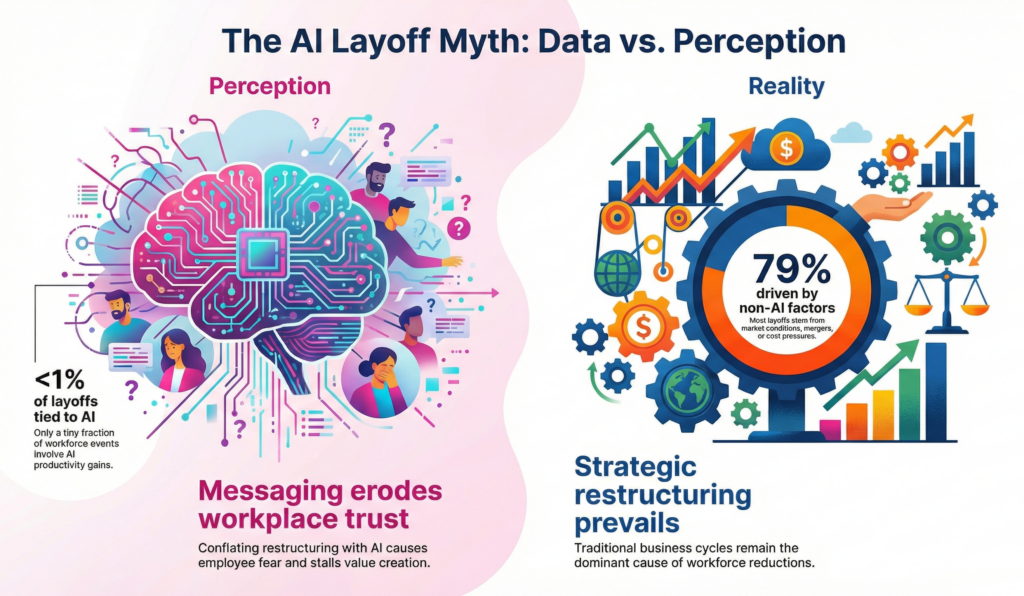
One of the most misunderstood aspects of AI adoption involves layoffs attribution. Gartner analyzed workforce events across 231 companies representing over 241,000 jobs between January and June 2025. Less than 1% of announced layoffs were attributable to AI productivity gains.
In contrast, 79% of layoffs had nothing to do with AI at all. They stemmed from market conditions, restructuring, mergers, or cost pressures. Executives may reference AI publicly, but the data tells us a different story.
This disconnect fuels unnecessary fear. When leaders conflate strategic restructuring with AI productivity, employees draw the wrong conclusions. Trust erodes. Adoption slows. Value creation stalls.
History Offers a Clear Pattern
The current moment is not unique. The robotics revolution of the 1970s and 1980s followed a similar arc. Robots and automation entered factories rapidly. Dangerous and repetitive tasks were assigned to machines. Predictions of mass unemployment followed.
Instead, humans and robots learned to work together. Entire industries emerged around robotics programming, maintenance, design, and optimization. Humans in factories did not entirely disappear. Rather, the jobs evolved.
The same pattern repeats across history. Each technological era eliminates certain roles while creating many more new roles. Professions once essential vanish. New ones appear unexpectedly.
Once, societies needed hunters, gatherers, and toolmakers. Those jobs disappeared entirely. Yet employment expanded dramatically with each successive age (stone, bronze, iron, dark, industrial, technological, robotic, and now AI). Human work did not end. It diversified, and changed. Many jobs became obsolete, while entirely new ones emerged. Do you remember the job of Esports Video Game Player – 30 years ago?
Real Risk: Unchecked Automation
The most serious risk today is not job loss. It is automation without governance. AI systems lack judgment, accountability, and initiative. Humans bring all three.
Unchecked automation may reduce costs briefly. Over time, it damages trust, brands, and compliance. This is especially dangerous in regulated and high-risk environments. Not every task belongs to a probabilistic system. Some decisions are better served by deterministic accuracy.
Large language models hallucinate. They guess confidently when uncertain. Using them indiscriminately creates risk. Businesses cannot afford that in high-impact workflows.
Responsible AI adoption requires discernment. It requires understanding which tasks are low risk. It requires deterministic systems where accuracy matters. It requires human oversight throughout.
From Hours Worked to Value Per Human
The most important mindset shift ahead involves productivity measurement. Organizations need to move past the ‘hours worked’ paradigm. We need to start thinking along the lines of measuring ‘value created per human’.
Research consistently shows that humans working WITH AI outperform either the humans alone or the AI working on its own. When AI handles repetitive tasks, people focus on strategy, judgment intensive, and exception cases. Accountability remains with the human employee. Overall outcomes improve.
This is AI augmentation, not replacement. The highest-performing organizations design workflows where responsible AI agents amplify human capabilities. Humans remain in control. AI remains governed.
This approach creates sustainable productivity gains. It also preserves trust internally and externally.
Job Reinvention, Not Elimination
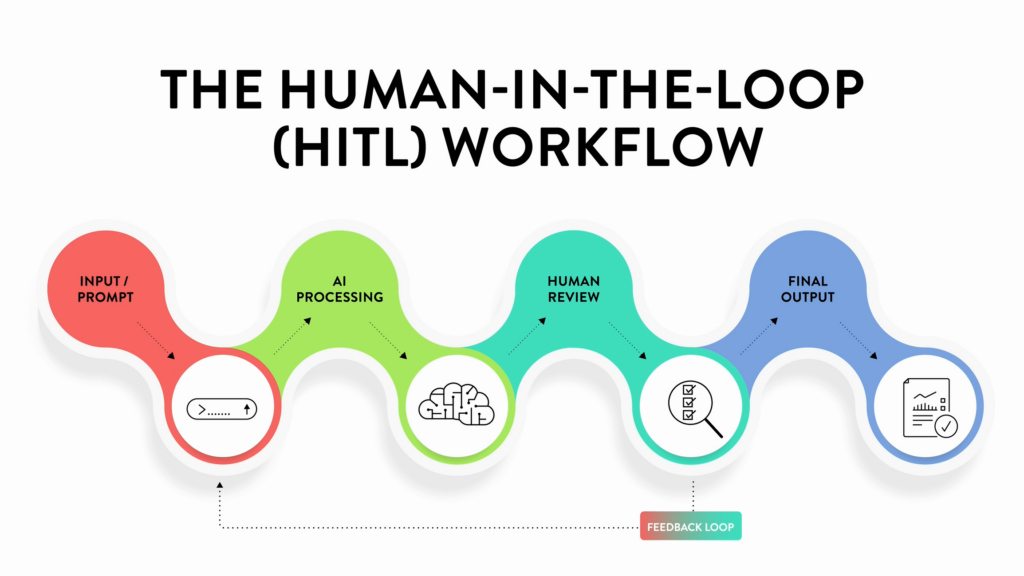
Responsible AI changes how work is done. It does not eliminate the need for people. Jobs evolve. Roles expand. Skills shift.
However, this evolution requires intention. Organizations need to understand risk levels. They need to match technology to task. Deterministic (knowledge graph AI) systems are essential for high-risk decisions. Generative AI systems fit exploratory or creative work. Better yet, use both as in kama.ai’s GenAI Sober Second Mind.
Unchecked automation may appear efficient initially. But, it often causes long-term damage. Responsible AI augmentation creates durable productivity and stronger engagement.
When humans remain accountable and AI is governed, and workflows are thought through – then outcomes improve across the organization.
A Clear Conclusion
AI will not cause a job apocalypse. History, economics, and current data all point elsewhere. However, ‘irresponsible AI’ might.
The organizations that succeed will not replace people fastest. They will make people more valuable. They will measure value per human. They will design systems with humans, not around them. These companies will use human-in-the-loop processes and approaches, and leverage Responsible AI technologies like those provided by kama.ai.
The future belongs to enterprises that pair responsible AI with accountable humans. That is how productivity grows. That is how trust endures.